The View from the Window: Why a Route Shapes a Journey
A route shapes a journey by linking changing scenes into one experience. Learn how to choose a seat, read transitions, and remember the passage.
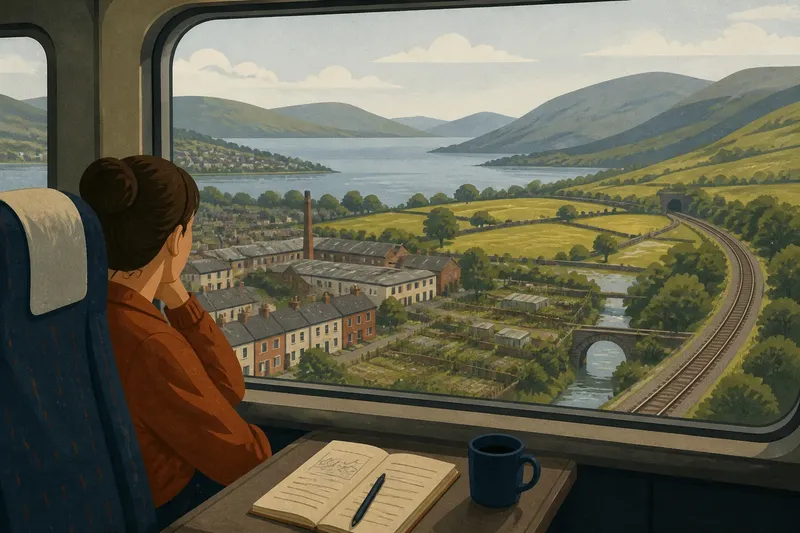
A route can make the stretch between two destinations feel like part of the trip, not dead time. The view from a train, ferry, or bus window gives you a sequence to follow: buildings thin out, the ground changes, and a different kind of light arrives. Noticing those transitions is a simple way to experience the journey as a connected story.
How does a route shape a journey?
A route shapes a journey by deciding which scenes arrive, in what order, and how one gives way to the next. A direct tunnel may deliver you quickly to a destination; a slower line through suburbs, fields, and a river crossing lets you feel the change from one kind of place to another.
That sequence creates continuity. A row of apartment blocks might give way to warehouses, then allotment gardens, then open land. None of those views needs to be spectacular. Together, they show the destination emerging from the landscape around it rather than appearing as an isolated point on a map.
Travelers often remember a transition more clearly than a single vista: the moment a coastline appears beyond a headland, or the last dense streets fall behind. A route makes that moment legible because you have seen what came before it.
What can the window reveal?
A window offers a moving cross-section of a place. Look at how land is used, where roads gather, how buildings change, and what follows a settlement. These details can suggest how people live with the terrain without requiring you to turn every view into a grand interpretation.
Notice the edges between settings. A rail line may pass from a cramped station district to light industrial yards, then to gardens and open fields. On a coastal bus, shopfronts might become holiday apartments before the road reaches working harbors. Edges are useful because they show change in progress.
Weather and light also alter what the route seems to say. Rain may bring the nearest rooftops and road markings into focus, while distant hills fade. In clear conditions, the far horizon can pull attention outward. You do not need to decide which view is better; simply note what the conditions bring forward and what they hide.
Keep your observations modest and concrete. “The houses became lower after the bridge” is more grounded than claiming that a whole region feels a certain way. A small detail can stay with you without having to stand for everyone who lives there.
Which seat gives the better view?
The better seat depends on the route, direction of travel, and what you want to notice. A window seat gives you an uninterrupted frame, but either side may face the more interesting landscape, and that can change as the vehicle turns.
Check the route map and, where available, a seat plan before choosing. Look for coastlines, river valleys, mountain slopes, or a major change in terrain, then consider which side may face them. Treat the map as a clue rather than a promise: bends, buildings, weather, and the direction of travel all affect what you can see.
On a ferry, an outside deck offers a broad view, while a cabin window can make the shoreline easier to watch in poor weather. On a bus, the front may give a longer view along the road, but passengers and stops can interrupt it. On a train, a window seat can be more useful than a particular side if the route changes direction repeatedly.
Say you are taking a train from a city toward a lake district and want to notice the shift from dense streets to open water. You check the route map, choose an available window seat on the side that appears to face the lakes, and keep a short note when the first broad view opens. If the train turns or the shore lies farther away than expected, the changing sequence still gives you a record of the approach.
Do not spend the whole journey trying to secure the theoretically perfect seat. If the view matters to you, make a sensible choice when booking; after that, let the route do its work from whatever seat you have.
How do you notice a transition?
Pick a few recurring cues instead of trying to absorb everything outside. Rooflines, road width, tree cover, water, and the density of buildings are easy to spot from a moving vehicle. Watching one or two of them change gives the passing view a thread.
Try this as you travel:
- Choose one feature, such as the height of buildings or the presence of water.
- Notice what it looks like near your starting point.
- Look again after a station, bridge, tunnel, or other clear threshold.
- Note what has changed and what has stayed the same.
- Connect the change to the next scene without guessing at its cause.
A tunnel or bridge can be a natural pause in the sequence. Before entering, notice the view; when you emerge, look for what has shifted. The contrast can make the landscape’s larger pattern easier to see, even when the ride itself is brief.
If you are traveling with someone, trade observations rather than demanding a running commentary. One person may notice how the road follows a river; another may see that the settlements cluster near station stops. A few distinct details are often more memorable than trying to describe every passing field.
What should you remember afterward?
Write down the order of a few scenes, not just the name of the destination. A short sequence such as “brick terraces, freight yards, vegetable plots, low hills” can help bring the passage back later. Add a threshold—the bridge, bend, or station after which the view changed—to give the sequence a clear hinge.
Keep notes close to what you could observe: the color of roofs, the distance between houses, the appearance of a river, or a change in the road. Avoid turning one passing view into a firm claim about a community or region. A window gives you a partial view, not the whole place.
Photographs can help when the light or arrangement of a scene matters, but they cannot keep the order of the route on their own. If you take one, add a brief note about what came before or after. Otherwise, a folder of disconnected images may preserve the views while losing the journey that connected them.
You can also leave the notebook closed for part of the ride. Watching without recording gives the sequence room to settle; a few notes at the end can capture what stayed with you. The aim is not to document every mile, but to retain enough of the passage that the destination still has an approach in your memory.
What do travelers ask?
Should I take the scenic route?
Choose it when the changing landscape is part of what you want from the trip and the extra time or connections fit your plans. If arriving promptly matters more, a direct route may suit you better; a window view does not need to justify every detour.
What if there is nothing to see?
Look for small transitions: a change in building materials, a line of trees beside the tracks, a road narrowing, or signs of water in the distance. If the view is blocked, the rhythm of stops, turns, and openings can still give the passage a shape.
How can I enjoy the view without missing my stop?
Set an arrival reminder and check the route display or timetable before you settle in. Then you can watch the landscape without relying on a last-minute glimpse of the station name.
Is a window seat necessary?
No. A window seat makes sustained looking easier, but you can still notice the route during station pauses, from an aisle seat, or on a deck where access is available. Pay attention when the view opens, rather than treating an uninterrupted seat as the only way to experience the passage.
Let the passage linger
A route becomes part of a journey when you pay attention to how one scene leads into another. The view from the window may be partial, changeable, or interrupted, but a few observed transitions can give the trip a shape that remains after arrival. For your next ride, choose one feature to follow and remember the point where it changed.