Before the Postcard View: How Travel Writing Learned to Notice
Travel writing becomes more vivid when you notice ordinary details: use sounds, gestures, textures, and small changes to make a place feel specific.
Travel writing gets more vivid when you record what happens before you reach the postcard view: a bus conductor’s hand on a ticket punch, the smell of damp stone in a doorway, or the pause before a shopkeeper answers. Famous sights can establish where you are, but ordinary details show how being there feels. To write that way, slow your attention down in a deliberate sequence: arrive, observe, select, record, and shape.
Arrive without a verdict
Before you decide what a place means, notice what your body encounters. Is the street easy to cross, or do you wait for a gap in traffic? Does the air feel dry against your face? Is the room louder near the entrance than beside the window? These are not grand conclusions. They are evidence of a particular moment.
Give yourself a short stretch of time before reaching for a sweeping description. Put the phone away, stand or sit somewhere you can observe without blocking anyone, and let the first impressions remain unfinished. You are not trying to empty your mind; you are postponing the urge to turn everything into a theme.
This restraint has a history in travel writing. Accounts built around celebrated monuments and scenic views often treated a place as something to behold and describe. Writers who turned toward street life, domestic routines, work, and passing encounters widened the account: the setting mattered, but so did the people moving through it and the traveler’s own position among them. You can make that shift on any trip by looking beyond what a guidebook marks as important.
Choose a small patch
Attention needs a manageable field. Choose a bench, a ferry terminal queue, a café doorway, or one stretch of sidewalk rather than trying to absorb an entire neighborhood at once. A smaller patch gives you enough time to notice changes without turning observation into an inventory.
Look at the scene in layers. Start with what is nearest: a chipped table edge, a paper cup softening in someone’s hand, a line of wet footprints. Then look across the space at movement and sound. Finally, notice what changes while you remain there: a shutter lifted, a chair carried outside, a conversation interrupted by a passing vehicle.
Use a simple prompt when your attention wanders: “What changed since I looked up?” It steers you away from collecting adjectives and toward events. A place begins to take shape through those small transitions, not through a string of claims that it is charming, chaotic, or timeless.
Follow the senses
Visual details are easy to collect and easy to overuse. To make a scene more specific, notice how the other senses organize it. A bakery may smell of warm bread near its counter and of wet coats by the entrance. A station may be announced by a rolling suitcase, a vendor calling to someone, and a draft that lifts the corner of a newspaper.
Record sensory details precisely, but keep your interpretation modest. “The metal handrail felt cold through my sleeve” gives a reader something to imagine. “The city was unfriendly” turns one sensation into a judgment about a whole place.
Pay attention to how senses combine. A sound can direct your eyes; a smell can tell you that a door has opened behind you. The sequence matters. “A bell rang, then a woman in a flour-dusted apron came through the side door” creates a small event. A list of the bell, the apron, and the door does not.
Notice people with care
Ordinary life often provides the clearest signs of a place, but people are not scenery. Describe visible actions rather than assigning a stranger a personality, motive, or private history. You can write that a passenger folded a map twice before putting it away; you cannot know from that gesture alone that the person was anxious or lost.
Be especially careful with photographs and identifying details. A person going about a private or vulnerable moment may not welcome becoming part of your account. You can often preserve what made a scene meaningful by describing its public setting, the action you observed, and your own response, without naming someone or exposing information they did not choose to share.
Also place yourself honestly in the scene. Were you waiting, passing through, buying something, or asking a question? Your position shapes what you could see and what you could not. A short admission of that limit makes an account more trustworthy than pretending to offer a complete portrait.
Keep a field note
Write while the details are still available, but do not try to produce finished prose on the spot. A pocket notebook works well when you can pause; a note on your phone is useful when standing still would be awkward. Capture fragments, sequence, and uncertainty rather than polished sentences.
- Place and position: Note the kind of space and where you stood or sat.
- Concrete details: Save a sound, texture, smell, object, or gesture that feels particular.
- Change: Record what happened before and after a small interruption or arrival.
- Your response: Note what you felt, expected, or misunderstood, without presenting that reaction as the place’s character.
- Open question: Mark anything you could not know, rather than filling the gap with a guess.
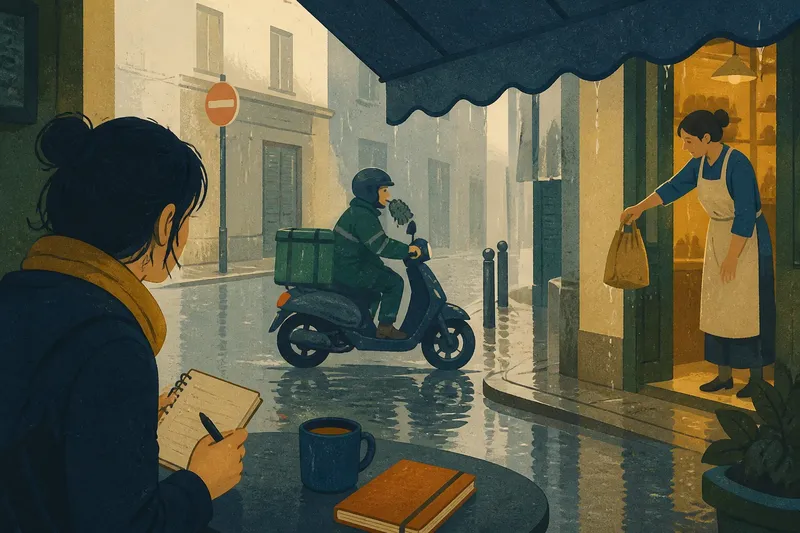
Imagine you are waiting under an awning while rain crosses a narrow street. Your notes say: “Water ticking on the sign; delivery rider holds one glove in his teeth; woman moves her paper bag away from the drip.” Later, you might shape those fragments into a short scene about how people adjust to the weather, while keeping clear that you saw actions, not private thoughts. The notes give you a specific starting point without pretending the moment explains the whole neighborhood.
Not every detail deserves a place in the notebook. It is not worth the effort to log every storefront, plate of food, or passing face. A few details connected by a change or a question will usually carry more than an exhaustive list.
Shape the scene?
How do I choose which details to keep?
Keep a detail if it helps a reader locate the scene, reveals a change, or complicates your first impression. If it does none of those things, leave it in your notes rather than forcing it into the piece.
How can I avoid making small details sound profound?
Let the observation remain ordinary unless the scene itself supports a larger meaning. A plastic stool wobbling on a tiled floor can stay a plastic stool; your account does not need to turn it into a symbol of an entire culture.
What if the scene seems uneventful?
Look for a small shift in sound, movement, light, or your own attention. If nothing changes, the stillness may be the useful detail, but describe what you can actually observe rather than decorating it with a dramatic interpretation.
Should I check details after I leave?
Check spellings, local terms, and factual claims when they matter to the account. Keep sensory memory separate from verified context, and mark a detail as uncertain if you cannot confirm it.
Build a brief passage
When you return to your notes, begin with a concrete action or sensory detail, then establish where you are. Add only the context a reader needs to understand what is happening. After that, let one change carry the passage forward: the door opens, the rain eases, a customer leaves, or you realize you have been standing in someone’s way.
Read the draft and check each sentence for its source. Did you see the gesture, hear the sound, or learn the background from a reliable source? If a sentence claims to know what a stranger felt or what a whole place is like, revise it into an observation or remove it. When the passage includes a local custom or a practical rule, confirm it with an appropriate source instead of treating one encounter as proof.
Then look for the traveler’s role. A scene is not a detached camera view: your pause, question, purchase, or mistake may be part of what happened. Include that role when it changes the account, but do not make yourself the center simply because you are the one holding the notebook.
Make attention portable
On your next trip, choose one ordinary pause and give it your full attention. Note where you are, what changes, and one detail you might otherwise have missed. That is enough to begin a scene before the famous view takes over.
Travel writing built from ordinary details does not reject landmarks; it gives them company. A cathedral, beach, or mountain can still anchor a story, while a ticket stub, a gust through an open door, or a brief exchange gives the reader a way into the lived place around it. The useful habit is simple: keep looking after you recognize the view.