A Market Morning, Planned with Room to Wander
Plan a market morning around one question, open browsing time, and a closing note so the visit leaves you with a vivid, specific memory.
A market morning works best when you carry one question, not a shopping list disguised as a schedule. For a market visit, that small prompt gives your attention somewhere to begin while leaving room for a stall, smell, or conversation to change the plan.
The aim is not to collect a complete portrait of a place. It is to notice one detail closely enough that you can recall the morning later, including how you came across it. The following walk-through is an invented situation, with a loose plan rather than a prescribed route.
A question to carry
Imagine you arrive at a covered neighborhood market in a town you have not visited before. You have the morning free, a pocket notebook, and no particular ingredient to buy. Before entering, you ask: How do people decide where to pause?
This question is useful because it points toward observable behavior without telling you what the answer should be. You might notice shoppers comparing produce, a vendor arranging a display, or someone stepping aside to greet a familiar face. The question is a starting lens, not a mission to prove a theory.
Choose a prompt that can be answered by watching, listening, or noticing your own choices. For instance, you might wonder what sound draws people toward a stall, how goods are presented for tasting, or what changes when a busy aisle opens up. Avoid questions that demand private information or turn other visitors into characters you feel entitled to inspect.
Time without a route
In the imagined visit, you decide on a simple shape: enter, make one unhurried pass, choose a place to pause, and leave time for a note before going. You do not assign a fixed order to the stalls. A market’s energy can shift from one aisle to the next, and a rigid itinerary can make you look past the very interruption that brought you there.
On the first pass, keep your question in mind but do not force every scene to answer it. Notice where people slow down, then look at what is happening around those pauses. Is there a sample on a counter, a handwritten sign, a narrow doorway, or simply room to stand without blocking others?
Browsing deserves its own space. If a mound of citrus catches your eye, stop to look at its color and scent; if a seller is busy with customers, keep moving rather than pressing for a conversation. You can return to a stall later if there is a natural opening. Wandering is not wasted time when it gives your attention a chance to settle.
Room for an encounter
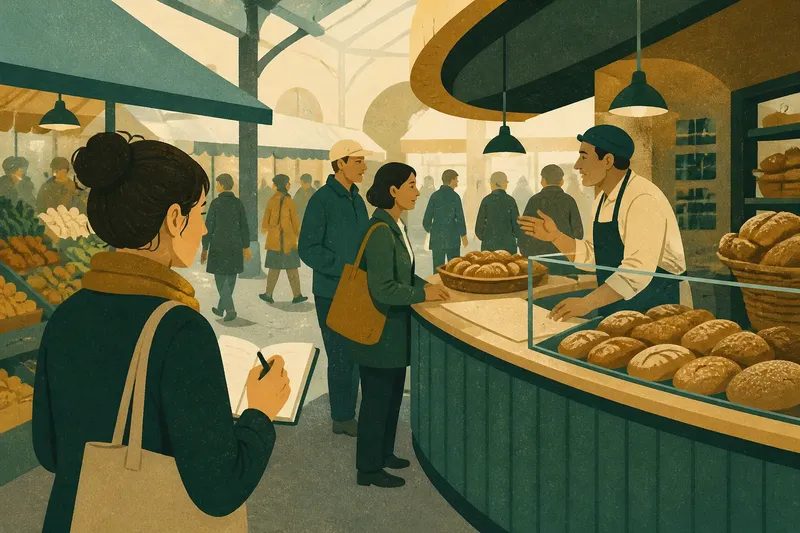
In this invented visit, you notice that people pause at a bread stall where the counter bends away from the main aisle. The arrangement leaves a small pocket for choosing without stopping the flow. That detail begins to answer your question, but it does not have to explain the whole market.
Suppose the baker is free and makes eye contact. You could ask a brief, relevant question about what is being prepared that morning, then listen without treating the answer as material you are owed. If the exchange stays short, let it stay short. If the person is serving a line, a sign or the rhythm of the stall may tell you enough.
For this imagined morning, the baker points out a tray of rolls cooling behind the counter and says customers often pause to choose while the next batch comes out. The observable result is modest: you see people wait at the curved counter, then step aside as the tray arrives. Your original question has helped you notice how the stall’s layout and timing shape a pause, while the encounter adds a human detail without turning the vendor into a symbol for the entire town.
A note before leaving
Before you exit, find a spot that does not obstruct a doorway or stall and write a few lines. Record the detail itself first: the counter’s curve, the warm smell near the tray, the way a customer moved aside. Then add what you wondered, what you saw, and what remains uncertain.
A useful note separates observation from interpretation. “Two customers waited near the bend, then moved toward the side when the tray appeared” is more grounded than “Everyone here is patient.” The first gives your memory something to return to; the second makes a broad claim from a brief scene.
In the hypothetical visit, you write that the bend in the counter made room for choosing, and that the fresh tray briefly changed where people stood. You also note that you do not know whether the arrangement works the same way on another morning. That qualification keeps the memory honest and leaves the scene open rather than forcing it into a tidy lesson.
What to leave out
It is not worth trying to record every stall, price tag, conversation, and passing face. A dense inventory can bury the one detail that made the morning feel distinct. Nor does every visit need a polished story attached to it; a clear note may be enough to preserve what you noticed.
Keep practical choices simple. Follow posted market rules, ask before photographing people or their work, and avoid blocking a counter while taking notes. If you buy something, make the purchase because you want it, not because you feel it will make the visit more authentic.
Questions to carry home?
What makes a good market question?
Choose something visible and open-ended, such as how people choose where to pause or what draws them toward a stall. A useful question can guide attention without requiring a stranger to share personal information.
Should I plan which stalls to visit?
Make a short list only if you have a practical need, such as finding a particular food or meeting someone. Otherwise, leave the order open and let the market’s layout and activity shape your wandering.
How do I remember a detail without taking photos?
Write down a physical cue and an action: the smell of warm bread beside a curved counter, or a shopper stepping aside as a tray arrives. A few precise words can prompt a fuller memory later without interrupting the moment.
What if nothing seems worth writing down?
Record the question you brought and what kept your attention from answering it. That gap may itself describe the morning accurately; you do not need to manufacture a striking encounter.
A market morning planned with room to wander can end with one well-kept observation rather than a complete account of everything you saw. In the imagined visit, the curved counter becomes the detail worth remembering because it connects a layout, a brief encounter, and a small shift in the crowd. Keep the note specific, and let the rest of the market remain larger than the story you carry away.